Understanding the HTTP Protocol: A Practical Guide for Developers
August 7, 2026
·4 min read
·
The Hypertext Transfer Protocol (HTTP) is the foundation of communication on the modern web. Whether you build frontend interfaces, design REST APIs, or manage backend infrastructure, a solid understanding of HTTP is essential for building, debugging, and maintaining web services.
This guide covers the core mechanics of HTTP, from request structures and status codes to protocol evolution and endpoint health check monitoring.
How HTTP Works: The Client-Server Model
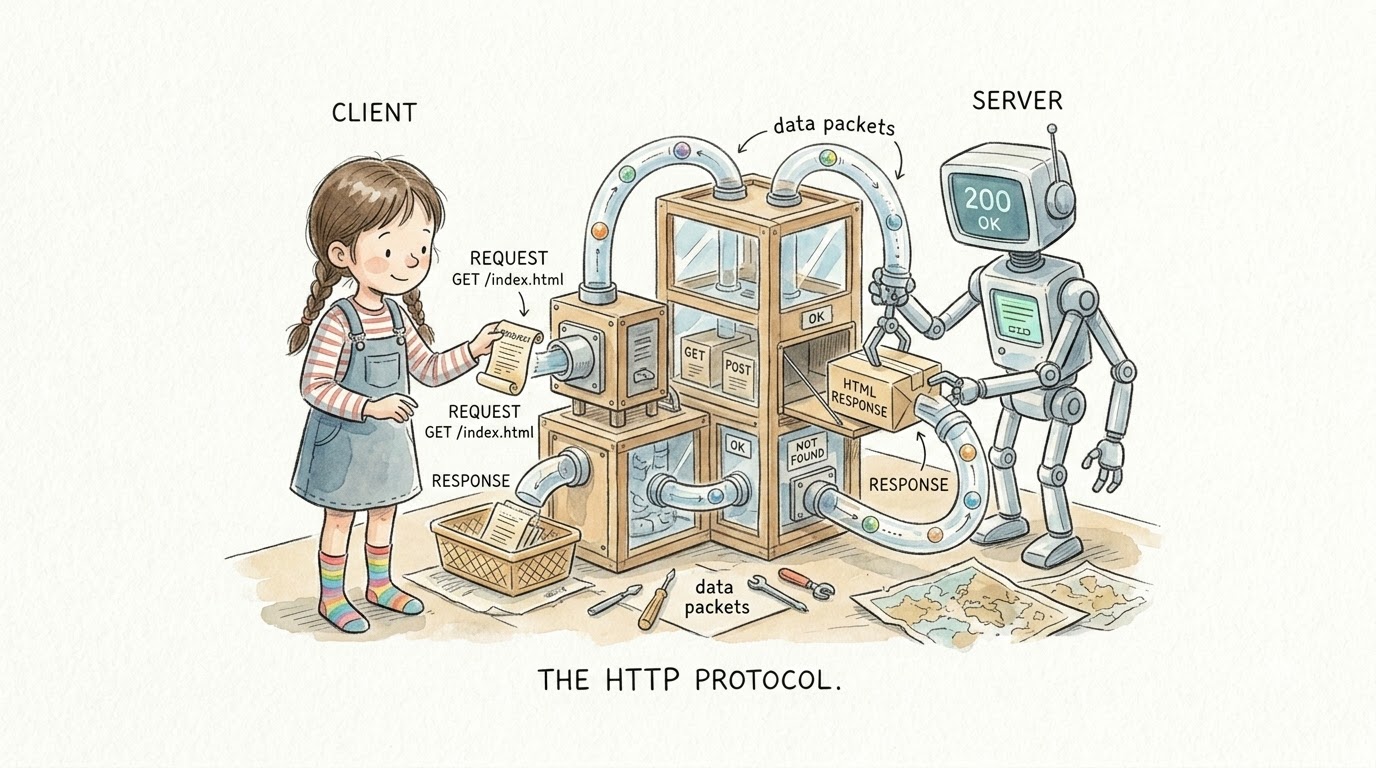
HTTP operates on a simple request-response architecture between a client and a server:
Client Request: A client (such as a browser, mobile app, or command-line tool like
curl) opens a network connection and sends an HTTP request to a target host.Server Processing: The server receives the request, parses headers and payload data, evaluates permissions, and executes backend logic.
Server Response: The server sends back an HTTP response containing a status code, response headers, and an optional body.
Connection Handling: Depending on the HTTP version and connection headers, the underlying connection is closed or reused for subsequent requests.
Structure of an HTTP Request
An HTTP request consists of three main parts: the request line, request headers, and an optional request body.
Request Line
The request line specifies the action to perform, the resource target, and the HTTP protocol version. The action is defined using standard HTTP methods:
GET: Requests data from a specified resource without altering server state.
POST: Sends payload data to the server to create a new resource or perform processing.
PUT: Replaces an existing target resource with the provided payload.
PATCH: Applies partial modifications to an existing resource.
DELETE: Removes the specified resource.
HEAD: Retrieves identical headers to a
GETrequest, but omits the response body.
Headers and Body
Request headers pass metadata to the server, such as client authorization, accepted content types, and host details. The message body contains the actual data payload, typically formatted as JSON, XML, or form data.
Here is an example of an HTTP/1.1 POST request:
POST /api/v1/users HTTP/1.1
Host: api.example.com
Content-Type: application/json
Authorization: Bearer token_xyz123

{
  "name": "Jane Doe",
  "email": "jane@example.com"
}
Structure of an HTTP Response
An HTTP response mirrors the request structure with a status line, response headers, and an optional response body.
Status Codes
HTTP status codes are three-digit integers categorized into five numerical ranges:
Range | Category | Common Code | Meaning |
|---|---|---|---|
1xx | Informational | 101 Switching Protocols | Server agrees to change connection protocols |
2xx | Success | 200 OK, 201 Created | Request processed successfully |
3xx | Redirection | 301 Moved Permanently | Resource moved to a new URI |
4xx | Client Error | 400 Bad Request, 404 Not Found | Request is invalid or resource missing |
5xx | Server Error | 500 Internal Error, 502 Bad Gateway | Server failed to execute request |
Here is an example of a typical HTTP response:
HTTP/1.1 201 Created
Content-Type: application/json
Date: Fri, 07 Aug 2026 07:40:00 GMT

{
  "id": "usr_99",
  "status": "created"
}
Core Characteristics of HTTP
Two fundamental properties define how applications interact over HTTP:
1. Statelessness
HTTP is stateless. Each request operates independently without automatic context from previous requests. Applications manage user sessions across requests using cookies, session tokens, or bearer headers.
2. Idempotency and Safety
Safe Methods: Operations that read data without altering server state (such as
GETorHEAD).Idempotent Methods: Operations where executing multiple identical requests produces the exact same server state as a single request (such as
GET,PUT, orDELETE).
Protocol Evolution: HTTP/1.1, HTTP/2, and HTTP/3
HTTP has evolved to address network latency, connection overhead, and resource concurrency:
Protocol Version | Transport Layer | Key Improvements |
|---|---|---|
HTTP/1.1 | TCP | Persistent connections and chunked transfer encoding |
HTTP/2 | TCP | Binary framing, HPACK header compression, and request multiplexing over a single connection |
HTTP/3 | QUIC (UDP) | Native stream encryption, reduced connection establishment latency, and elimination of TCP head-of-line blocking |
Monitoring HTTP Endpoint Health
Understanding HTTP allows you to inspect and maintain application availability effectively. Web services can degrade due to connection timeouts, incorrect HTTP status codes, or malformed response payloads.
Crystade simplifies HTTP endpoint monitoring by running active probes across HTTP/1.1 and HTTP/2 protocols. It measures key network metrics—such as Time to DNS Resolved (TTDR), Time to First Byte (TTFB), and Round Trip Time (RTT)—while asserting expected status codes, headers, and JSON bodies. Integrated with incident management, custom alerts, and status pages, Crystade keeps your web services reliable.
Summary
HTTP relies on a client-server request-response architecture.
Requests combine methods (
GET,POST,PUT,DELETE), headers, and optional payloads.Status codes indicate execution state, grouped from 1xx (Informational) to 5xx (Server Errors).
Modern HTTP versions (HTTP/2 and HTTP/3) improve network efficiency through multiplexing and modern transport protocols.
Monitoring HTTP status codes and response metrics ensures production services remain performant and accessible.
Share this post
Related Posts
Keep reading from this category

Master Cron Job Expressions: Syntax, Examples, and Best Practices
Learn how to read, write, and debug cron job expressions. Explore syntax rules, special characters, practical examples, and production monitoring strategies.

Understanding TCP: Architecture, Handshakes, and Monitoring
Learn how the TCP protocol establishes reliable connections, executes handshakes, and manages data flow. Discover how active TCP monitoring prevents critical outages.


Demystifying OSI and TCP/IP Networking Models
Learn the core differences between OSI and TCP/IP networking models and discover how understanding layers improves system monitoring and reliability.
